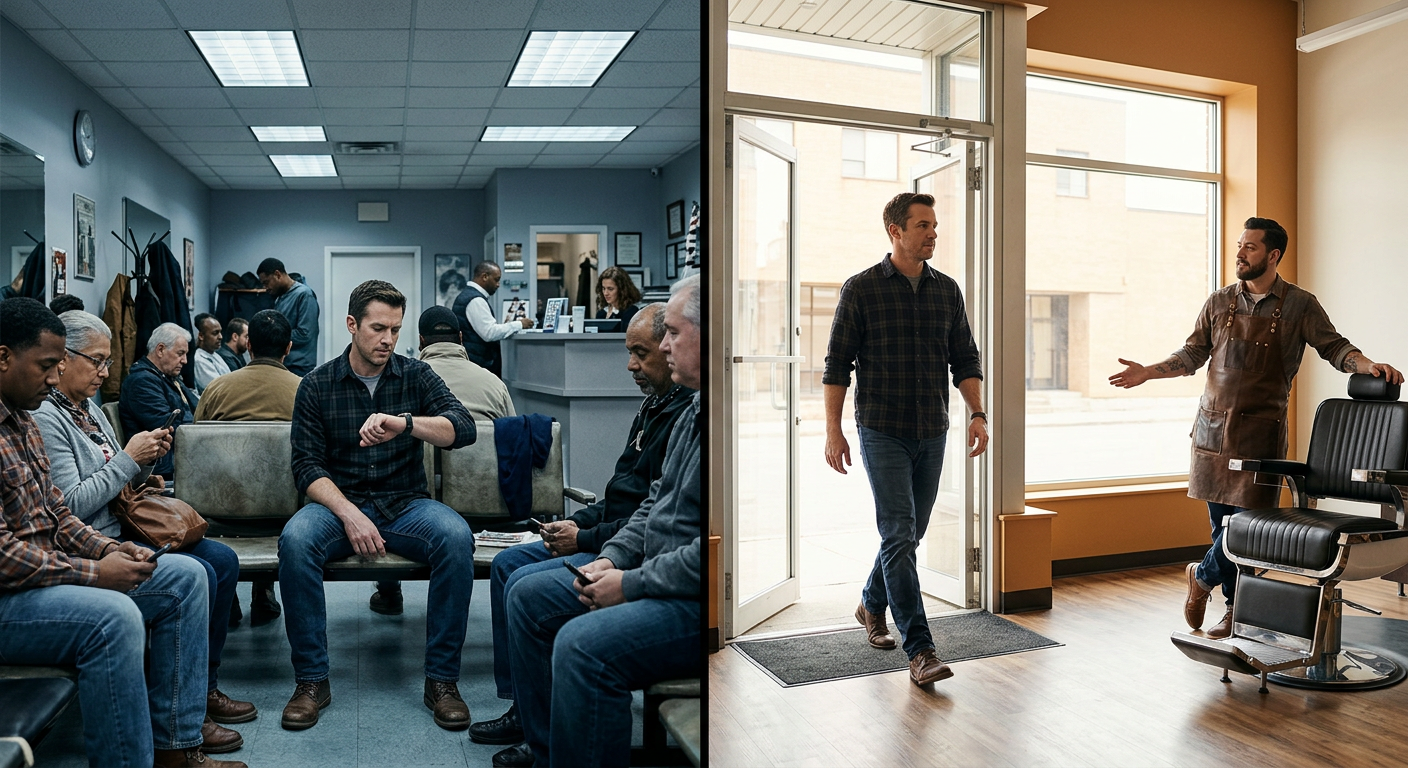
The Walk-In Bet: What You're Actually Gambling With
You're betting 40 minutes of your Saturday that the barbershop around the corner isn't packed. Most guys lose that bet at least twice a month.
Here's what actually happens: You drive 10 minutes to the shop, walk in, see four people ahead of you, and now you're committed. You've already invested the travel time. Leaving means admitting you wasted it. So you sit down, pull out your phone, and start the wait.
That's the walk-in gamble. You're not just betting on wait time — you're betting on whether your preferred barber is working, whether he's available, and whether the guy who just walked in ahead of you wants a simple trim or a full cut with a beard sculpt and hot towel treatment.
Average wait times at walk-in shops by time of day and day of week
The data on walk-in wait times isn't published by shops (for obvious reasons), but ask any barber and the patterns are consistent:
Weekday mornings (7am-11am): 5-15 minute wait. Mostly retirees and shift workers. Your best odds.
Weekday lunch (11am-2pm): 20-35 minutes. Office workers on lunch breaks create a surge. The shop looks empty at 11:45am, packed by 12:10pm.
Weekday late afternoon (4pm-7pm): 25-45 minutes. After-work crowd. Every chair full, waiting area at capacity.
Saturday morning (8am-12pm): 35-60 minutes. The worst odds of the week. Every guy who couldn't make it during the week shows up. Some shops stop taking walk-ins by 10am.
Saturday afternoon (12pm-5pm): 30-50 minutes. Still bad, slightly better than morning.
Sunday (where available): 20-40 minutes. Fewer shops open, but also fewer customers. A wash.
These aren't guarantees — they're probability ranges. Which means every walk-in is a bet on where you'll land in that range.
The Real Time Cost of a Walk-In Haircut
Let's do the actual math on what a "quick" walk-in haircut costs in time.
Travel + wait + cut + travel: the full math
Assume you're going to a walk-in barbershop near me on a Saturday morning (because that's when most guys go):
- Travel to shop: 10 minutes (average urban/suburban drive)
- Wait time: 40 minutes (middle of the Saturday morning range)
- Haircut duration: 25 minutes (standard men's cut with fade)
- Travel back: 10 minutes
Total time invested: 85 minutes
Of that 85 minutes, only 25 minutes are the actual service you wanted. The other 60 minutes are overhead — time spent getting to and waiting for the thing you came for.
Now run the same math on a Tuesday at 10am (a low-traffic window):
- Travel: 10 minutes
- Wait: 10 minutes
- Cut: 25 minutes
- Travel back: 10 minutes
Total: 55 minutes
The difference between a good walk-in bet and a bad one is 30 minutes. That's the variance you're accepting every time you show up without knowing what you're walking into.
Compare that to a booked appointment:
- Travel: 10 minutes
- Wait: 0-5 minutes (barber finishing up previous client)
- Cut: 25 minutes
- Travel back: 10 minutes
Total: 45-50 minutes
The booked appointment eliminates the variance. You know what you're getting. The time cost is predictable.
What a Booked Appointment Actually Guarantees
Online booking isn't just about skipping the wait. It's about locking in three specific things that walk-ins can't guarantee.
Specific barber, specific time, no waiting room roulette
When you book a barber online, you're reserving a chair with a specific person at a specific time. That matters more than most guys realize.
Walk into a busy shop and you get whoever's next available. Maybe that's the senior barber who's been cutting hair for 20 years. Maybe it's the new guy who's still learning to blend a mid fade. You don't know until you sit down.
With appointment scheduling, you pick your barber. You can see their work, read reviews, and decide if their style matches what you want. If you're particular about your haircut (and if you're reading this, you probably are), that's not a small thing.
The specific time guarantee is the other half. You're not showing up and hoping. You're showing up at 2:30pm because your barber is expecting you at 2:30pm. He's not in the middle of another cut. He's not on break. He's ready.
That predictability has a dollar value. If you bill your time at $50/hour (roughly $100k annual salary), that 30-minute variance on a bad walk-in day costs you $25. Do that twice a month and you're losing $600/year to waiting room roulette.
(Yes, you're not literally billing that waiting room time. But you could be using it for something else — a workout, meal prep, an extra hour of sleep, time with your kids. The opportunity cost is real.)
What geo-location search actually shows you
Searching "walk in barbershop near me" tells you where shops are. It doesn't tell you which ones are good, which barbers are working today, or how long you'll wait.
A curated booking platform shows you:
- Which barbers have availability in the next 2 hours, 2 days, or 2 weeks
- What their specialties are (fades, classic cuts, beard work)
- What previous clients said about them
- Exactly when you can get in
That's not the same as a map pin and a phone number.
When Walk-Ins Still Make Sense
This isn't a blanket argument against walk-ins. There are scenarios where they're the right move.
You have a flexible schedule and low time sensitivity. If you're retired, work from home with control over your calendar, or have a free afternoon with nothing planned — walk-ins are fine. The wait becomes optional downtime, not stolen time.
You're in an unfamiliar city and need a same-day cut. Traveling for work and realized you need a cleanup before a meeting tomorrow? Walking into a well-reviewed shop is faster than trying to navigate an unfamiliar booking system.
You're getting a simple buzz cut or low-maintenance style. If any competent barber can execute what you want in 10 minutes, the "specific barber" advantage of booking doesn't matter. Roll the dice.
The shop is small and the owner knows you. Some neighborhood barbershops run on relationships. The owner knows your name, your cut, your schedule. You walk in, he waves you to the chair or tells you "20 minutes." That's a different dynamic than a walk-in at a busy chain.
But for most guys, most of the time? Walk-ins are a bet you don't need to make.
The 3-Minute Booking Argument
What you give up vs. what you get back
Booking an appointment takes 3 minutes:
- Open the platform
- Pick your barber (or filter by availability, style, or rating)
- Select a time slot
- Confirm
That's it. No phone calls, no "let me check the schedule and call you back," no showing up to see if they can fit you in.
Those 3 minutes buy you:
- Elimination of wait time variance: You know you're getting a chair at 3pm, not sometime between 2:30pm and 4pm
- Barber selection: You're not getting whoever's next — you're getting the person whose work you've seen and liked
- Calendar integration: The appointment goes in your phone. You get a reminder. You don't forget and miss the window.
- No awkward lobby time: You're not sitting in a waiting area making small talk with strangers or pretending to read a 6-month-old magazine
The first time you book a specific barber near you in under 3 minutes and walk in at exactly your appointment time while three guys are still waiting from their walk-in gamble, the 3-minute investment pays for itself.
After that, it's pure time savings.
The mental cost of uncertainty
There's a hidden cost to walk-ins that doesn't show up in the time math: the uncertainty tax.
You don't know if you'll get the barber you want. You don't know how long you'll wait. You don't know if the shop is even open (some close early on slow days, or the barber called in sick).
That uncertainty means you can't plan the rest of your day tightly. You can't schedule a 2pm meeting if you're walking into a barbershop at 12:30pm with no idea when you'll be done. You build in buffer time — which is just another form of wasted time.
Booking removes that. You know you'll be in the chair from 2pm to 2:25pm. You can plan a 3pm call. You can hit the gym after. You can pick up your kid from practice at 4pm without wondering if you'll make it.
That's not a luxury. That's basic time management.
The Real Question Isn't Preference — It's Priorities
Most articles on this topic frame it as a personality thing: some guys like the spontaneity of walk-ins, others prefer the structure of appointments.
That's not what this is about.
It's about whether you treat your time as finite and valuable, or as an infinite resource you can afford to gamble with.
If you're fine with 40-minute waits and unpredictable schedules, walk-ins work. If you'd rather spend those 40 minutes doing literally anything else, booking works better.
The walk-in vs. booked debate isn't really about preference. It's about how much your time is worth — and whether you're willing to spend 3 minutes to stop wasting it.
For more on getting the cut you actually want once you're in the chair, read how to communicate your cut to any barber, walk-in or booked. And if you're trying a new shop for the first time, here's how to not get a bad cut when you don't have a relationship with the barber yet.