The Straight Razor Shave Isn't a Gimmick
You've probably walked past a barbershop with a vintage straight razor displayed in the window and thought it was either a nostalgic prop or something only trust-fund guys with too much time get done. Here's what nobody tells you: if you have coarse facial hair, sensitive skin that reacts to multi-blade cartridges, or chronic razor burn from shaving at home, a proper straight razor shave is the most practical solution you're ignoring.
The catch? Most barbershops that advertise this service have no idea what they're doing. They'll slap a hot towel on your face for thirty seconds, drag a blade across your skin at the wrong angle, and send you out looking like you lost a fight with a cat. A skilled barber who actually knows straight razor technique can give you the closest shave you'll ever get without irritation. The difference isn't subtle.
This isn't about luxury or tradition. It's about understanding what you're paying for and knowing how to spot a shop that does it right. Let's walk through the full sequence — from the hot towel prep to the post-shave treatment — so you know exactly what should happen and what separates competence from theater.
Step 1: The Hot Towel Treatment and Why It's Not Optional
The hot towel isn't ambiance. It's the foundation of the entire shave. Most shops that half-ass this step run the towel under warm tap water, wring it out, and drape it over your face for maybe a minute. That does almost nothing.
A proper hot towel treatment uses water heated to around 130-140°F — hot enough that the barber has to handle it with care, not hot enough to burn your skin. The towel stays on your face for 3-5 minutes, sometimes with a second application. During this time, three things are happening:
- Your hair follicles are softening. Facial hair is coarse — about as tough as copper wire of the same diameter. Heat and moisture break down the keratin structure temporarily, making the hair pliable enough to cut cleanly without tugging.
- Your pores are opening. This isn't mystical spa talk. Heat causes vasodilation in the skin, which relaxes the follicles and allows the blade to get closer to the root without forcing it.
- Your skin is being prepped for oil absorption. Dry skin and a sharp blade are a recipe for micro-cuts and irritation. The heat creates the right surface for pre-shave oil to actually penetrate.
If the towel comes off and your face feels lukewarm instead of genuinely heated, the barber just skipped the most important step. Everything that follows will be harder on your skin.
What the heat actually does to your skin and hair follicles
The temperature threshold matters. Below 110°F, you're getting minimal follicle softening. Above 145°F, you risk damaging the skin's moisture barrier. The sweet spot is that 130-140°F range, maintained long enough for heat to penetrate past the surface layer.
Coarse or curly facial hair benefits most from this prep because the hair shaft has more resistance. If you've ever tried to shave immediately after waking up versus after a hot shower, you've felt the difference. The hot towel treatment replicates that shower effect — but does it better because the heat is focused and sustained on your face, not diluted across your entire body.
Some shops add essential oils to the towel (eucalyptus, tea tree, sandalwood). This isn't just for scent. Eucalyptus has mild antimicrobial properties and helps open airways if you're congested. Tea tree oil reduces inflammation. Sandalwood calms skin that's prone to redness. If a shop is using these, they're thinking about the shave as a treatment, not a transaction.
After the towel comes off, a skilled barber applies pre-shave oil. This is a thin layer — usually a blend of jojoba, argan, or grapeseed oil — that creates a microscopic buffer between the blade and your skin. It's not about lubrication (that's what the shaving cream does). It's about preventing the blade from catching on dry patches or uneven skin texture.
The Shave Itself: What a Skilled Barber Does Differently
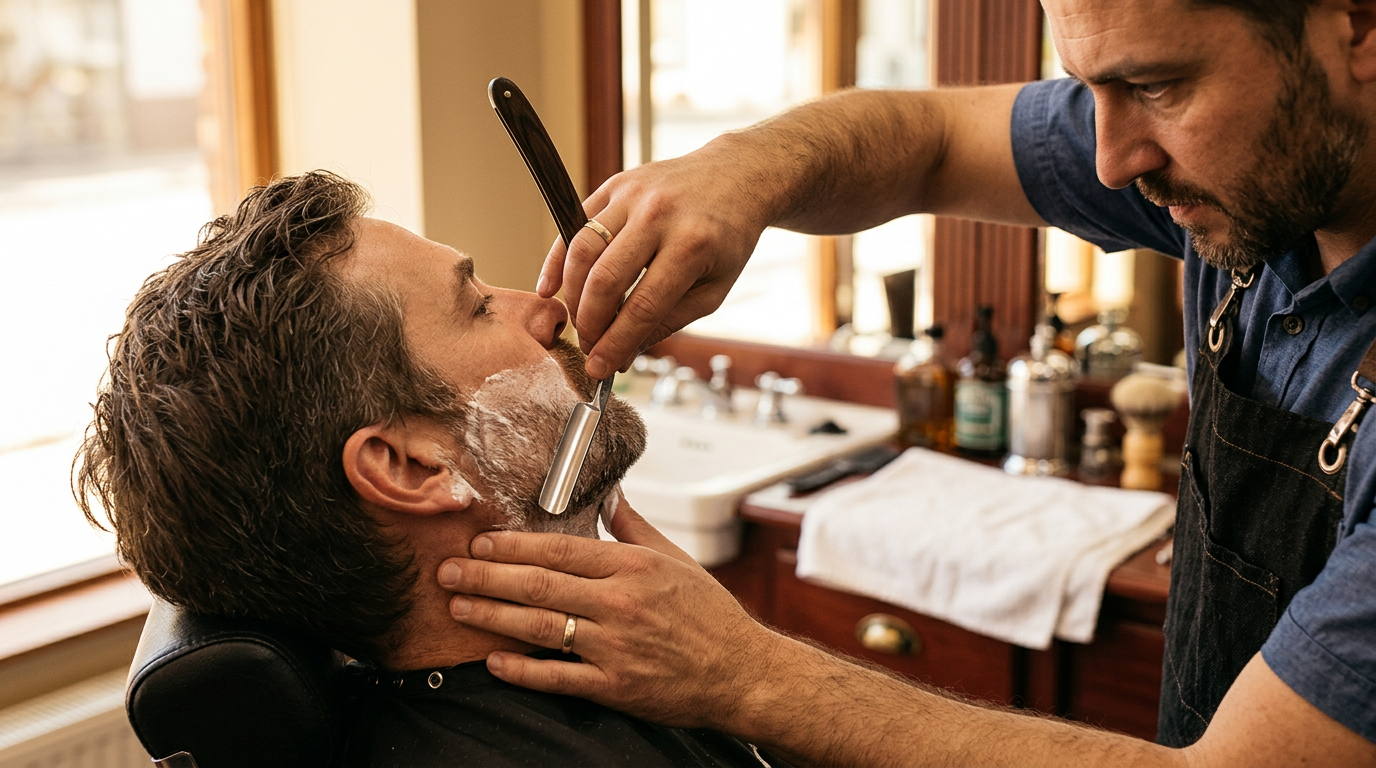
This is where you find out if your barber actually knows what they're doing. A straight razor shave isn't just "dragging a blade across your face slowly." The technique involves blade angle, skin tension, and grain direction — and if any of these are wrong, you're getting cut or walking out with irritation.
First pass: the barber shaves with the grain. Not against it. This is counterintuitive because most guys think "against the grain = closer shave," but with a straight razor, going against the grain on the first pass is how you get razor burn and ingrown hairs. The blade is sharp enough (we're talking 8,000-12,000 grit edge sharpness) that a with-the-grain pass removes more hair than a cartridge razor's against-the-grain pass.
The barber holds the blade at roughly a 30-degree angle to your skin. Too steep (closer to 45 degrees) and the blade scrapes instead of slices. Too shallow (closer to 15 degrees) and it skips over the hair without cutting. You can actually hear the difference — a proper angle produces a clean, almost silent cut. A bad angle sounds scratchy.
Skin tension is the variable most guys don't think about. The barber uses their free hand to pull your skin taut in the direction opposite to the blade's movement. This does two things: it lifts the hair slightly away from the skin (making it easier to cut at the base) and creates a flat surface for the blade to glide across. If your barber isn't actively stretching your skin with their other hand, they're not doing it right.
Second pass: the barber reapplies lather and shaves across the grain. This is the pass that gets you from "clean-shaven" to "actually smooth." It removes the hair that the first pass missed without the irritation risk of going fully against the grain.
Some barbers do a third pass against the grain for clients who want the absolute closest shave possible. This is optional and depends on your skin sensitivity. If you have coarse hair and tough skin, a third pass might be fine. If you're prone to razor bumps or have sensitive skin, stop at two passes.
Blade angle, skin tension, and grain direction
Here's what separates a barber who's been doing this for years from one who learned it in a weekend workshop: the ability to adjust technique in real-time based on your face.
Your jawline isn't a flat plane. Your neck has curves and angles. The area under your nose is tight and awkward. A skilled barber changes the blade angle slightly for each section — steeper on the flatter parts of your cheeks, shallower on the curves of your jaw and neck.
Grain direction isn't uniform across your face. Most guys have hair that grows straight down on their cheeks, but the neck is where it gets complicated. Some men have hair that grows horizontally on the sides of the neck, or even upward in patches. A good barber maps your grain direction before starting — either by feel or by asking you about your shaving patterns. If they don't do this, they're guessing.
The number of strokes matters too. More passes with the blade = more irritation risk. A skilled barber gets it done in as few strokes as possible, which requires confidence and precision. If your barber is going over the same spot repeatedly, they either don't have a sharp blade or don't trust their technique.
Blade sharpness is non-negotiable. A dull straight razor is more dangerous than a sharp one because it requires pressure to cut, which increases the chance of slipping and nicking you. Professional barbers hone their blades on a leather strop before every shave. If you don't see your barber strop the blade in front of you, ask about it. It's a legitimate question, not a rude one.
After the Blade: Beard Conditioning and Scalp Massage
Most guys think the shave is over once the blade is done. That's like thinking a haircut is finished after the clippers stop — technically true, but you're missing half the service.
After the final pass, the barber wipes off the remaining lather with a warm towel (not as hot as the initial one, but warm enough to open pores again). Then comes the cold towel. This isn't optional. The cold towel closes your pores, tightens the skin, and stops any micro-bleeding from spots where the blade came too close.
The temperature shock — hot to cold — also reduces inflammation. If you've ever noticed that your face feels slightly puffy or red after shaving at home, it's because you skipped this step. The cold towel brings everything back to baseline.
Next: post-shave treatment. This is where shops vary widely. At minimum, you should get an alcohol-free aftershave balm. Alcohol-based aftershaves sting because they're drying out your skin, which is the opposite of what you want after a blade just removed your top layer of dead skin cells. A good post-shave balm contains aloe, witch hazel, or chamomile — ingredients that soothe irritation and hydrate.
Some shops include beard conditioning even if you just got a clean shave. This sounds backwards, but it's not. Beard conditioner (or beard oil) applied to freshly shaved skin prevents the dryness and tightness that shows up 2-3 hours later. It's essentially pre-treating your skin for the irritation that would otherwise develop.
Why the post-shave ritual matters as much as the shave
The post-shave phase determines how your skin looks tomorrow, not just today. If a barber rushes through this part, you'll know by tomorrow afternoon when your face feels raw or you start seeing red bumps.
The scalp massage that some shops include isn't filler time. It's a lymphatic drainage technique that reduces facial puffiness and promotes circulation. After your face has been pulled and stretched during the shave, the massage resets everything. It also just feels excellent, which is a legitimate part of the value you're paying for.
A proper post-shave routine should take 5-7 minutes. Cold towel, balm application, optional beard oil, and massage. If your barber is done in under 3 minutes, they're skipping steps.
One more thing: sun sensitivity. For the 24 hours after a straight razor shave, your skin is more vulnerable to UV damage because you've removed the outermost protective layer. A good barber will mention this and might even apply a light SPF moisturizer as the final step. If they don't mention it, remember it yourself — wear sunscreen or avoid prolonged sun exposure the day after your shave.
What You Should Expect to Pay — and What's Overpriced
A straight razor shave at a professional barbershop typically runs $35-$75, depending on your city and the shop's positioning. Here's how to evaluate whether the price is justified:
$35-$45 range: This is fair for a competent shave in most mid-sized cities. You're getting the hot towel, the shave, and basic post-shave treatment. The barber knows what they're doing but isn't spending extra time on luxuries like extended massage or premium products.
$50-$65 range: This is standard in major metro areas (New York, San Francisco, Chicago) or at shops that position themselves as upscale. At this price point, you should expect premium shaving cream (not canned foam), high-quality aftershave products, and a more thorough post-shave routine. The experience should feel unhurried.
$70+ range: You're paying for atmosphere, location, or brand. Some high-end shops charge this much because they're in expensive real estate or they've built a reputation. The shave itself probably isn't meaningfully better than the $50-65 version, but you might get extras like a complimentary drink, a longer scalp massage, or a more private setting.
Here's what's overpriced: any shop charging $80+ for a straight razor shave unless they're including additional services (like a haircut or facial treatment). The labor and skill involved in a shave tops out around $65 in value. Beyond that, you're paying for branding.
Also overpriced: shops that charge $50+ but use disposable blade straight razors instead of traditional honed blades. Disposable blade razors (the kind that look like straight razors but have replaceable cartridges) are easier for the barber but don't give as close a shave. They're fine for sanitation purposes, but if you're paying premium prices, you should be getting a traditional straight razor that's been stropped fresh for your shave.
One cost consideration: frequency. If you're getting a straight razor shave weekly, you're spending $140-$300/month. That's steep unless you have a specific need (sensitive skin that can't handle home shaving, professional appearance requirements). Most guys who get regular straight razor shaves do it every 2-3 weeks as a reset, then maintain with home shaving in between.
Tipping: expect to add 20% on top of the service price. If your barber did an exceptional job — no nicks, great conversation, took their time — 25% is appropriate. For more on this, see how much you should actually tip your barber.
How to Find a Barbershop Near You That Actually Offers This Service
Not every barbershop offers straight razor shaves, and of those that do, not all do it well. Here's how to find a shop that knows what they're doing:
Check the service menu on their website or booking platform. If "straight razor shave" or "hot towel shave" is listed as a standalone service with a specific price, that's a good sign. If it's vaguely mentioned as an "add-on" or "available upon request," the shop probably doesn't do many of them.
Look at reviews that specifically mention shaves, not just haircuts. Search for phrases like "hot towel," "straight razor," or "traditional shave" in the reviews. If multiple people mention it positively, the shop has consistent technique. If reviews only talk about haircuts, the shop might technically offer shaves but rarely performs them — which means the barbers are out of practice.
When you call or visit, ask: "Do your barbers use traditional straight razors or disposable blade razors?" There's no wrong answer here, but it tells you what to expect. If they say disposable, that's fine for sanitation but know you're not getting the closest possible shave. If they say traditional and they strop the blade in front of you, that's the real deal.
Ask how long the service takes. A proper straight razor shave takes 35-45 minutes minimum. If they tell you 20-25 minutes, they're rushing it. You want a shop that blocks out enough time to do it right.
Some shops specialize in traditional barbering and make shaves a core part of their business. These are your best bet. Look for shops with vintage or classic aesthetics — not because the decor matters, but because shops that invest in that atmosphere usually take traditional services seriously.
If you're trying to find a barbershop near you that offers straight razor shaves, look for shops that list it prominently and have barbers who've been trained specifically in blade work, not just clippers and scissors. The skill sets overlap but aren't identical.
One warning sign: shops that advertise "luxury shave experience" but don't list a specific price. That's often a sign they're overcharging for ambiance rather than skill. Transparency in pricing usually correlates with confidence in the service.
Another approach: ask your current barber if they offer it, even if it's not on the menu. Some barbers are trained in straight razor technique but don't advertise it because there's not enough demand. If you're a regular client, they might be willing to do it by appointment.
So Is It Worth It?
If you have coarse facial hair, sensitive skin, or chronic irritation from cartridge razors — yes, absolutely. A proper straight razor shave solves problems that home shaving creates. The closeness lasts longer (3-5 days of smoothness versus 1-2 days from a cartridge), and if done correctly, there's zero irritation.
If you have fine hair and no shaving issues, it's more about the experience than necessity. You'll get a close shave, but you might not notice a dramatic difference from what you achieve at home. In that case, it's worth trying once to see if you value the ritual and the results enough to make it a regular thing.
The key variable is the barber. A skilled barber with a sharp blade and proper technique will give you the best shave of your life. A mediocre barber with dull equipment will give you nicks, irritation, and regret. The service itself isn't a gimmick — but the execution determines whether it's worth your time and money.
If you've never had one, try it once at a shop with strong reviews for their shave service specifically. You'll know within the first five minutes (during the hot towel prep) whether they're serious about it. And if it's done right, you'll understand why some guys make this a regular part of their grooming routine instead of a once-a-year novelty.