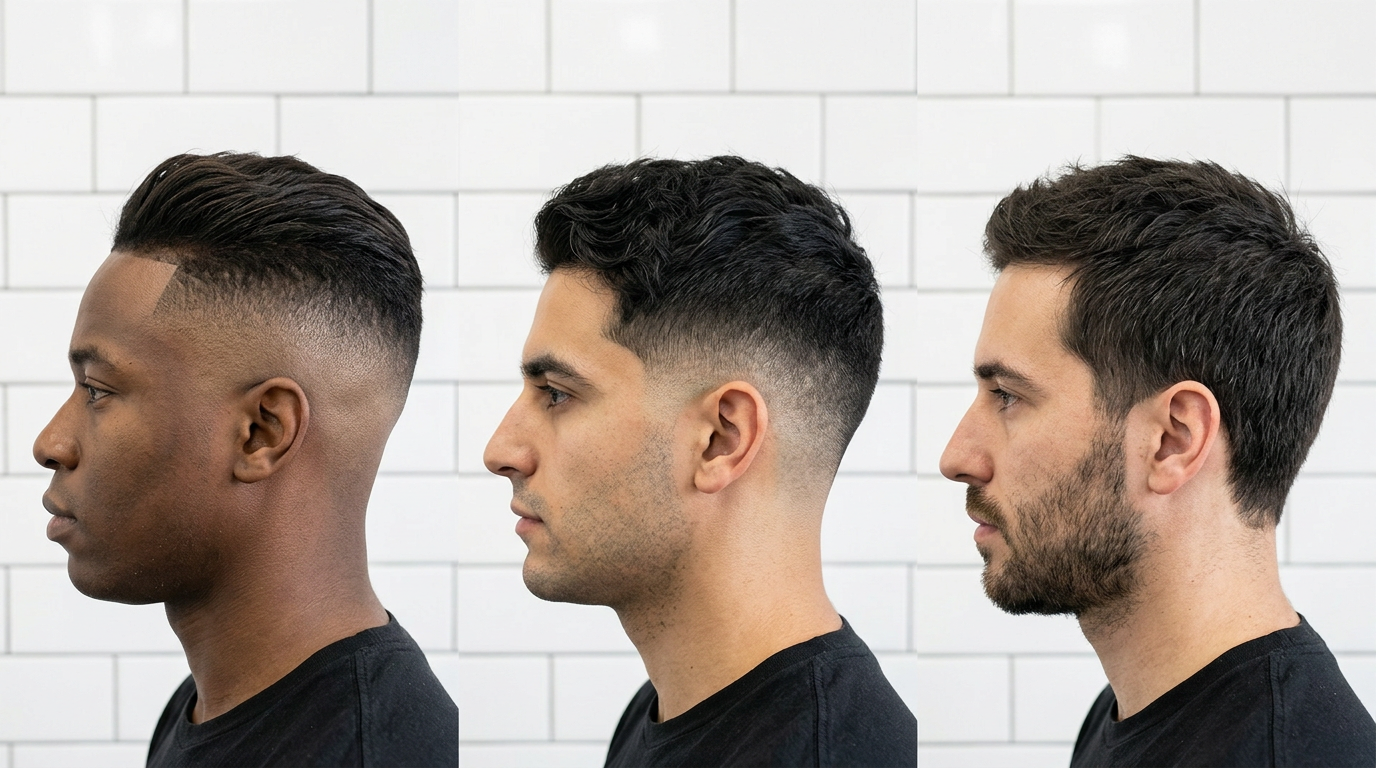
Why 'Just Give Me a Fade' Gets You a Different Haircut Every Time
You walk into three different barbershops over three months and ask for "a fade." You get three completely different haircuts. One barber takes your sides down to skin. Another leaves visible stubble. The third gives you what looks like a business-appropriate taper. You're confused. They're not wrong — you are.
The word "fade" has become the most overloaded term in men's grooming. It describes at least three distinct cutting techniques, each with different visual outcomes, maintenance requirements, and skill levels. When you say "fade" without qualifiers, you're essentially saying "I'd like some food" at a restaurant. The barber has to guess whether you want a taper cut, a skin fade, or a standard fade — and their default interpretation might not match the picture in your head.
The vocabulary problem
Here's what actually happens in that communication gap: A barber trained in traditional techniques hears "fade" and thinks taper — a gradual blend that leaves visible hair at the shortest point. A barber who came up in the Instagram era hears "fade" and defaults to skin fade — taking the sides down to bare scalp. The client, meanwhile, saw a photo on Pinterest labeled "fade" that could have been either one.
This isn't about barbers not listening. It's about an industry that uses the same vocabulary to describe fundamentally different haircuts. The result: you leave the chair with a cut that's technically well-executed but not what you wanted. You can't even articulate what went wrong because you don't have the language to describe the difference.
The solution isn't showing a photo (though that helps). It's understanding three core distinctions and one simple rule that closes the vocabulary gap in about ten seconds. Let's fix this.
What a Standard Fade Actually Is
A standard fade is a gradient. That's the technical definition. The hair transitions from one length to another over a vertical distance, creating a visual blend. Unlike a taper (which we'll get to), a true fade uses clipper-over-comb technique and multiple guard lengths to create a smooth transition without visible lines.
Think of it like a color gradient in Photoshop — you can see where it starts and where it ends, but you can't point to the exact moment one shade becomes another. That's what a skilled fade looks like on your head. The hair doesn't "step down" in visible increments; it flows.
The confusion starts because "fade" describes the technique, not the starting point. A fade can begin at skin level (skin fade), at a #1 guard (low fade with texture), or at a #2 guard (standard fade). The gradient is the same — only the baseline changes.
How the gradient works and where it starts
Here's what happens during a standard fade: The barber selects a bottom length (let's say a #1 guard — 1/8 inch). They select a top length where the fade will blend into the longer hair on top (usually 1-2 inches). Then they create the gradient between those two points using progressively longer guards and clipper-over-comb work to eliminate lines.
The vertical distance of that blend determines how dramatic the fade looks. A tight fade compresses the gradient into 1-2 inches of vertical space — you go from short to long quickly, creating a sharp contrast. A gradual fade stretches the blend over 3-4 inches, making the transition almost imperceptible. Same technique. Different visual impact.
Most men don't know to specify this. They say "fade" and hope the barber reads their mind about how aggressive they want the gradient. Spoiler: the barber can't.
Low fade, mid fade, high fade — the three positions
Now we add the second variable: where the fade starts on your head. This is positional, and it changes the entire aesthetic of the cut.
Low fade: The gradient starts about an inch above your ear. The shortest hair sits just above your natural hairline. This is the most conservative option — it maintains more coverage on the sides and works well in professional environments. If you have a corporate job and someone in HR has opinions about "appropriate grooming," this is your move.
Mid fade: The gradient starts roughly at the top of your ear, about temple-level. This is the most popular position because it balances modern style with versatility. You can wear it in a business casual office without raising eyebrows, but it still looks intentional and current. Most barbers default to this when you don't specify.
High fade: The gradient starts 2-3 inches above your ear, near the top of your head's side panel. This creates maximum contrast between the short sides and the longer top. It's visually aggressive — you're committing to a statement cut. High fades also grow out faster in a noticeable way, so you're looking at touch-ups every 10-14 days if you want to maintain the look.
When you say "fade" without specifying low, mid, or high, the barber picks one based on your face shape, their training, or what they did for the last three clients. You might get lucky. You might not.
The Skin Fade: What Makes It Different (and Why It Requires More Skill)
A skin fade isn't just a "really short fade." It's a structural departure from the standard fade because the baseline is zero — bare skin. No guard, no stubble, just scalp. This changes the technical approach and the maintenance reality.
The skill gap between a decent standard fade and a clean skin fade is significant. With a standard fade, small imperfections in the blend hide in the texture of the hair. With a skin fade, there's nowhere to hide. Every line, every uneven transition, every spot the barber missed — it's all visible because you're working against bare skin as the canvas.
Taking the hair to zero — what that means technically
To create a skin fade, the barber uses a combination of clipper work and razor detailing. The clipper takes the hair down as close as possible (usually with a #0000 blade or a foil shaver). Then they use a straight razor or trimmer to clean up the hairline and create the sharp boundary where skin meets hair.
The gradient from skin to longer hair has to be compressed into about 1-2 inches of vertical space, or it looks unfinished. That's a tight blend. The barber is essentially creating a smooth transition from nothing to something in a very short distance. It requires precision, steady hands, and an understanding of how different hair textures respond to clipper angles.
This is why you can't get a skin fade at every barbershop. Some barbers simply don't have the technical skill or the patience. Others don't want to spend 45 minutes on a cut that they're charging $35 for. If you want a skin fade, you need to book a barber near you who specializes in fades and tapers — someone who lists it explicitly in their portfolio and charges accordingly.
Why skin fades require more frequent touch-ups
Here's the maintenance reality no one tells you: a skin fade looks perfect for about four days. By day seven, the skin portion has visible stubble. By day ten, the gradient you paid for has blurred into a generic short haircut. By day fourteen, you don't have a fade anymore — you have a grown-out cut that needs to be redone from scratch.
This isn't a flaw in the technique. It's the physics of hair growth. When your baseline is zero, every millimeter of growth is visible. Compare that to a standard fade starting at a #1 guard: you have a buffer. The hair can grow a few millimeters before the blend starts looking fuzzy.
If you can't realistically get to a barbershop every 10-14 days, a skin fade is the wrong cut for you. You'll spend two weeks looking great and two weeks looking like you need a haircut. A standard fade or a taper gives you 3-4 weeks of solid presentation before it needs attention.
The Taper Cut: The One Most Men Actually Want
Here's the thing: when most men say "fade," they actually want a taper. They want their hair shorter on the sides than on top, with a clean transition and no visible lines. They don't want to commit to the drama of a true fade, and they definitely don't want to book appointments every two weeks.
A taper gives you that. It's the low-maintenance, professional-appropriate, works-with-any-face-shape option that solves 80% of men's haircut needs. But because the vocabulary has shifted, guys don't know to ask for it.
Taper vs. fade — the key structural difference
A taper is a variation of a fade haircut, but the execution is different. With a fade, the barber creates a gradient using multiple guard lengths and blending techniques. With a taper, the hair gradually gets shorter as it approaches the hairline, but the transition is less dramatic and the shortest length is never zero.
Think of it this way: a fade is about the blend. A taper is about the shape. The taper follows the natural contours of your head, getting shorter near the ears and neckline while maintaining visible length throughout. You can run your hand up the side of a taper and feel the hair the entire way. With a fade, you hit skin or near-skin at the bottom.
The visual difference: a taper looks like a well-groomed, conservative haircut. A fade looks like an intentional style choice. Neither is better — they serve different purposes. But if you're showing up to a law firm, a hospital, or a client-facing corporate role, the taper is what you want.
Why tapers work better for professional settings
Tapers have two advantages in conservative environments: they're subtle, and they age gracefully. A taper doesn't announce itself. It looks neat and deliberate without drawing attention. The guy in the meeting isn't thinking about your haircut — which is exactly the point in professional contexts.
The aging factor matters more than most guys realize. A fresh fade looks sharp for a week, then starts to blur. A fresh taper looks good for three weeks, then looks slightly grown out — but still presentable. If you travel for work or have unpredictable schedules, that two-week buffer is the difference between always looking put-together and occasionally looking scruffy.
Here's my take: if you're under 25 and work in a creative field, get the fade. If you're over 30 and work anywhere with a dress code, get the taper. If you're somewhere in between, alternate and see which one fits your actual lifestyle better.
The 3-2-1 Rule: How to Tell Your Barber Exactly What You Want
Now we get to the practical tool that solves the vocabulary problem. The 3-2-1 haircut rule is a clipper length guide that lets you describe your ideal cut in one sentence. It's not industry-standard terminology (yet), but it's becoming common language among barbers who are tired of the "fade" guessing game.
Here's how it works: you specify three numbers that correspond to the clipper guard lengths at three points on your head. Top. Sides. Baseline. That's it. No ambiguity, no interpretation, no surprises.
What the numbers mean on clipper guards
Clipper guards are numbered 0-8, with each number representing a specific hair length:
- #0: No guard (nearly skin, about 1/16 inch)
- #1: 1/8 inch
- #2: 1/4 inch
- #3: 3/8 inch
- #4: 1/2 inch
- #5: 5/8 inch
- #6: 3/4 inch
- #7: 7/8 inch
- #8: 1 inch
When you use the 3-2-1 rule, you're telling the barber exactly what guard to use at each zone. Example: "I want a 4 on top, 2 on the sides, 1 at the baseline." The barber now knows: leave half an inch on top, take the sides to 1/4 inch, and bring the baseline down to 1/8 inch. They'll create the gradient between those points. No guessing.
How to use the rule to describe your ideal fade in 10 seconds
Let's walk through three common cuts using the 3-2-1 framework:
Conservative taper (professional setting): "I want a 5 on top, 3 on the sides, 2 at the baseline. Low taper, not a fade."
Translation: Keep the top at 5/8 inch, sides at 3/8 inch, baseline at 1/4 inch. The gradient is gentle, and nothing goes to skin. This is the lawyer/consultant/finance haircut.
Modern mid fade (versatile, current): "I want a 6 on top, 2 on the sides, 1 at the baseline. Mid fade, blend it tight."
Translation: Top at 3/4 inch, sides at 1/4 inch, baseline at 1/8 inch. The fade starts at temple level and compresses the gradient for a sharp look. This works in business casual environments and still looks intentional.
Aggressive high skin fade (statement cut): "I want a 7 on top, 1 on the sides, skin at the baseline. High fade, take it up to the temple."
Translation: Top at 7/8 inch, sides at 1/8 inch, baseline at zero. Maximum contrast, maximum maintenance. This is the Instagram cut.
Notice what you're NOT saying: "Just give me a fade." You're giving the barber a blueprint. They can still apply their skill to the blend and the detailing, but they're working from your specifications — not their assumptions.
Which Cut Should You Actually Get?
The right answer depends on three variables: your face shape, your hair texture, and how often you can realistically get back to the barbershop. Let's break it down.
By face shape
Round face: You want height on top and shorter sides to elongate your face vertically. Go with a mid or high fade (standard or skin) with at least a #6 on top. The contrast between the short sides and longer top creates the illusion of length. Avoid low tapers — they make round faces look wider.
Oval face: You won the genetic lottery. Literally any of these cuts will work. Oval faces have balanced proportions, so you can go conservative taper or aggressive skin fade based purely on preference and lifestyle. Experiment.
Square/angular face: You already have strong lines. A skin fade emphasizes that — which can look great or too harsh depending on your features. Most square-faced guys look better with a standard fade or taper that softens the overall look rather than amplifying the angles. Try a low fade with a #2 baseline before committing to skin.
Long/rectangular face: You need width, not height. A low fade with more length on the sides (start at a #3 or #4) balances the proportions. Avoid high fades — they make long faces look longer. If you're going for a taper, keep the top shorter (around a #5) so you're not adding vertical length.
By hair texture
Straight hair: Shows every imperfection in the blend. If you have straight hair, you need a skilled barber — especially for skin fades. The good news: straight hair also holds the shape of a fade longer than curly hair. You can stretch appointments to 3 weeks with a standard fade.
Wavy hair: The texture helps hide minor blend imperfections, but it also grows out in unpredictable directions. Wavy-haired guys should avoid ultra-tight fades because the grow-out phase looks messy. A standard fade with a #1 or #2 baseline gives you a buffer.
Curly/coily hair: Fades on curly hair are a different art form. The curl pattern compresses the visual length, so a #2 guard on curly hair looks shorter than a #2 on straight hair. Most curly-haired guys need to go one guard length longer than they think. Also: curly hair hides blend lines, which means you can get away with a less precise fade. But the grow-out happens faster because the hair grows out AND up.
Thick/coarse hair: You need a barber who knows how to thin and texture. Thick hair can make a fade look bulky if the barber doesn't remove internal weight. Ask for texturizing on the top and make sure they're using thinning shears, not just clippers. A standard fade works better than a skin fade because the baseline has enough hair to blend smoothly.
Fine/thin hair: Skin fades and high fades can make thinning more obvious by creating too much contrast. You're better off with a low taper or a standard fade with a #2 baseline. The goal is to create shape without exposing thinning areas.
By how often you can realistically get back to the barbershop
Every 10-14 days: You can do a skin fade or a high fade. You're committing to frequent maintenance, but you'll always look sharp. This is realistic if you have a barber within 10 minutes of your house or office and you can book consistent appointments.
Every 3 weeks: Standard fade with a #1 or #2 baseline, or a low taper. You'll look great for two weeks, presentable for the third week, and due for a cut by week four. This is the sweet spot for most guys.
Every 4-6 weeks: Taper cut, no question. A true fade will look grown out by week four. A taper will look slightly longer but still intentional. If you travel frequently or have unpredictable schedules, this is your only realistic option.
Every 2+ months: You're not maintaining a fade or a taper — you're getting periodic resets. In that case, go with a longer cut overall (start at a #6 or #7 on top, #4 on sides) and accept that you'll cycle between "fresh cut" and "needs a cut" without much middle ground.
How to Book a Barber Who Actually Specializes in the Cut You Want
Here's what most guys do wrong: they pick a barbershop based on proximity or price, then hope the barber can execute whatever cut they're asking for. That's backwards. Not every barber specializes in every technique. A barber who does excellent traditional tapers might not have the skill set for a tight skin fade. A barber who crushes high-contrast fades might rush through a conservative taper because it's not their forte.
Look at the barber's portfolio before you book. Most barbers post their work on Instagram or on the booking platform. Scroll through 10-15 cuts. Do you see the style you want? Do you see it executed cleanly on multiple different clients? If yes, book them. If no, keep looking.
What to look for in a portfolio:
- Consistency: The same level of quality across different hair types and face shapes. One great cut could be luck. Ten great cuts is skill.
- Clean lines: Zoom in on the hairline and the fade transition. Are the lines crisp? Is the gradient smooth, or can you see "steps" where one guard length ends and another begins?
- Appropriate lighting: If every portfolio photo is shot in moody, low-contrast lighting, the barber might be hiding imperfections. Look for natural light photos where you can see the actual blend.
- Client variety: A barber who only posts one type of cut (e.g., all high skin fades on young guys with thick hair) might not be versatile. If you don't fit that profile, you're a guinea pig.
When you book, include a note with your appointment: "Looking for a [low/mid/high] [standard fade/skin fade/taper]. I have [straight/wavy/curly] hair and want to keep maintenance to [every 2 weeks/every 3 weeks/every month]." A good barber will read that and know exactly what you need. A mediocre barber will ignore it and do what they always do.
If you're in a new city or trying a new shop, start with a lower-stakes cut. Don't go for a high skin fade on your first visit. Get a mid fade or a taper, see how the barber handles it, and then escalate to more technical cuts once you've established trust. For more on navigating a first appointment, check out what to do at a new barbershop to avoid a bad cut.
The Vocabulary You Actually Need
You don't need to become a barber to get a good haircut. You just need to close the vocabulary gap. Here's your cheat sheet:
- Fade: A gradient blend from short to long. Specify low/mid/high to indicate where it starts.
- Skin fade: A fade that goes to bare skin at the baseline. High maintenance, high impact.
- Taper: A gradual shortening toward the hairline without going to skin. Professional, versatile, lower maintenance.
- 3-2-1 rule: Top length, side length, baseline length using clipper guard numbers. Use this to eliminate ambiguity.
- Blend: The transition between lengths. "Tight blend" = compressed gradient. "Gradual blend" = stretched gradient.
- Baseline: The shortest point of the cut, usually near the hairline.
Next time you sit in the chair, don't say "just give me a fade." Say: "I want a mid fade, #6 on top, #2 on the sides, #1 at the baseline, tight blend." The barber will know exactly what you mean. You'll get exactly what you want. And you'll stop cycling through barbershops wondering why the same request produces different results.
That's the difference between hoping your barber reads your mind and giving them a blueprint. The vocabulary gap is real. Now you know how to close it.