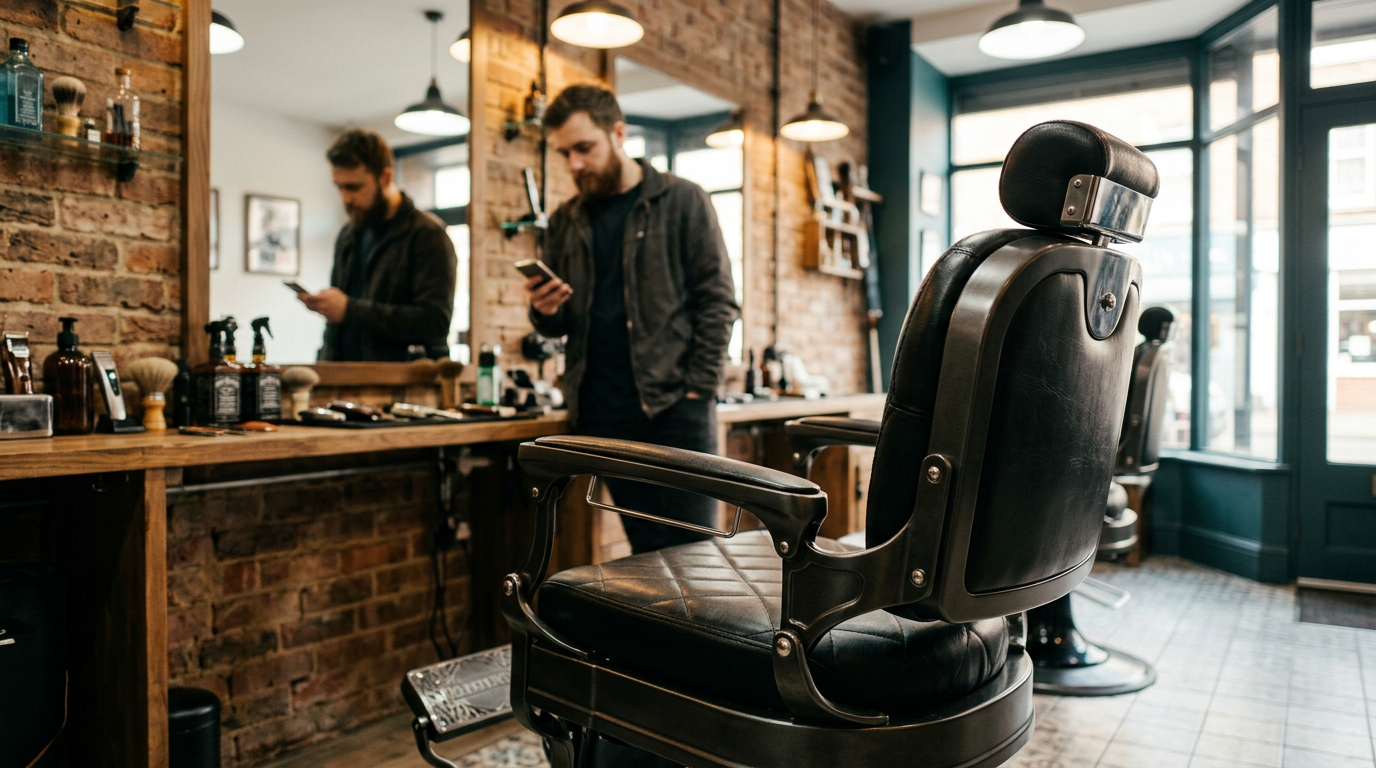
Why the First Visit to a New Barber Is the Riskiest One
You've just moved to a new city, or you're finally ditching the guy who's been butchering your fade for the past year. You search "find a barber near me," scroll through a dozen shops that all look the same, and pick one. You walk in — or book online — and hope for the best.
That hope? It's a strategy with about a 40% success rate.
The first haircut at a new barbershop is a test you don't know you're taking. Most men fail it not because they picked a bad barber, but because they communicated like a bad client. They sit down, say "just clean it up," and wonder why they walk out looking like someone else's idea of clean.
Here's the reality: your old barber knew what you meant when you said "the usual." This new one doesn't. You're starting from zero, and the first 60 seconds in that chair determine whether you'll become a regular or start searching "best barber near me" again next month.
The risk isn't just a bad haircut — it's wasting 4-6 weeks growing out a mistake while you look for someone else. That's the cost of getting this wrong.
Before You Sit Down: What to Know and What to Bring
Walk into a new shop prepared, or walk out disappointed. It's that binary.
Before you even book the appointment, do this: check the shop's Instagram or website. Look at their actual work — not just the hero shots, but the everyday cuts they post. If every photo is a high-skin fade with a hard part, and you want a textured crop, keep scrolling. Barbers specialize. You're looking for evidence they can execute YOUR style, not just A style.
If you're booking online (which you should — more on that in a moment), read the barber bios. Some shops let you book by service only; others let you choose a specific barber. Choose the barber. Look for:
- Years of experience (3+ minimum if you have a specific style in mind)
- Specialty mentions ("fades," "textured cuts," "classic styles")
- Client reviews that mention communication, not just speed
What to bring to the appointment:
- A reference photo — not of a celebrity in perfect lighting, but an actual haircut photo that shows the sides, back, and top clearly
- Your last good haircut in mind — be ready to describe what worked and what didn't
- Realistic expectations — if your hair is thin and straight, that thick wavy quiff in the photo isn't happening
What NOT to bring:
- Vague instructions ("just make it look good")
- Five different reference photos showing five different styles
- An attitude that the barber should "just know" what you want
Reference photos: how to use them without being annoying
Reference photos work when used correctly. Most men use them incorrectly.
The mistake: showing a photo and saying "I want this exactly." The barber looks at your hair texture, density, and growth pattern — none of which match the photo — and knows it won't work. Now they're stuck either executing a bad plan or talking you out of it, and you haven't even started yet.
The right way: show the photo and say, "This is the general shape I'm going for — what would work with my hair?"
That one sentence changes the dynamic. You've communicated a direction, not a demand. The barber can now adapt the concept to your actual hair, which is what good barbers do.
Here's what makes a good reference photo:
- Shows the haircut from at least two angles (front and side minimum)
- Features someone with similar hair texture to yours (don't show a photo of thick, coarse hair if yours is fine)
- Is a HAIRCUT photo, not a styled photo from a fashion shoot (you want to see the cut, not the product and lighting)
- Comes from a barbershop Instagram or portfolio, not a Pinterest board of models
Bad reference photos: magazine covers, movie stills, photos where you can't see the actual hairline or fade transition, photos of wet or heavily styled hair where the cut structure is invisible.
If you don't have a reference photo, that's fine — but you need the next tool.
The 3-2-1 rule as your communication shortcut
Most men have heard of the 3-2-1 rule and still don't know what it actually means. Let's fix that.
The 321 rule refers to a haircut length guide for clippers — specifically, the guard numbers and how they create a fade. It's shorthand for: 3 on top, 2 on the sides, 1 at the bottom (or some variation). But it's not just about the numbers. It's about giving your barber a LENGTH FRAMEWORK so they know where to start.
Here's how to actually use it:
If you know your current lengths: "I usually do a 4 on top, blended down to a 2, with a 1 at the baseline."
That sentence tells the barber:
- How much length you want on top
- That you want a fade ("blended down")
- Where the shortest point should be
If you DON'T know your lengths: "I want about an inch and a half on top, short on the sides but not skin, and a gradual fade."
That works too. The barber translates "an inch and a half" to a guard number (probably a 4 or 5), "short but not skin" to a 2 or 3, and "gradual fade" to a blend technique.
What the 3-2-1 rule is NOT:
- A universal haircut formula (your 3-2-1 might be someone else's 5-3-1)
- A replacement for describing the overall style
- Something you MUST use (it's a tool, not a requirement)
Why this matters on a first visit: length is objective. "Short" means different things to different people. A 2 guard is a 2 guard everywhere. If you can speak in numbers, you remove ambiguity.
If you have no idea what numbers you want, ask the barber to tell you what they're using as they go. Take a photo of the back of your head after the cut. Next time, you'll know.
What to Say in the First 60 Seconds
The consultation is not small talk. It's the blueprint.
When you sit down, the barber will (or should) ask you questions. How you answer determines the outcome. Here's the structure:
Open with your goal, not your method:
❌ "Can you do a mid fade?" ✅ "I want a clean, professional look that's low-maintenance — thinking a mid fade would work."
The first version assumes you know what you want. The second invites collaboration. If a mid fade isn't the best option for your hair, the barber can say so.
Describe your last haircut:
"Last time, the sides were too short and it looked too harsh. I want more of a gradual transition this time."
That gives the barber a reference point AND a correction. They now know what to avoid.
Mention your styling routine (or lack of it):
"I don't use product" is critical information. If you say nothing, the barber might give you a cut that requires pomade and a blow-dryer to look right. Then you walk out, it air-dries into chaos, and you blame the barber.
If you don't style your hair, say that. The cut needs to work without product.
State any non-negotiables:
"I need to keep enough length on top to comb over" or "I don't want any skin showing" — these are boundaries. Most men assume the barber will intuit them. They won't.
The three questions every good barber will ask you
If the barber doesn't ask these questions, you're in the wrong chair:
"What are we doing today?" — This is your opening. Don't say "whatever you think." The barber doesn't know what you think looks good.
"How do you usually style it?" — This reveals whether the cut needs to be product-dependent or air-dry friendly. If they don't ask, volunteer it.
"What didn't work last time?" or "What do you want to change?" — If they skip this, they're cutting blind. A good barber wants to know what you're trying to fix.
If you get all three questions, you're dealing with a professional. If you get none, finish the cut and don't come back.
One more thing: don't apologize for having preferences. "I know this is picky, but..." — stop. You're paying for a service. Communicating clearly isn't picky. It's basic.
Walk-In vs. Booked Appointment at a New Shop
When you don't know anyone at the shop, walking in is gambling. Booking in advance is loading the dice.
Here's what happens with a walk-in at a new barbershop: you get whoever is available. That might be the owner who's been cutting for 20 years. It might be the new hire who started last month. You have no idea, and by the time you figure it out, you're already caped up.
Walk-in barbershops work when you're a regular. The shop knows you, you know the barbers, and you trust that whoever takes you will do it right. On a first visit? You're rolling dice.
Why walk-ins are a gamble when you don't know the barbers:
- You can't vet the barber's work beforehand (no portfolio review, no client feedback)
- You get whoever is free, not whoever is GOOD at your style
- Busy shops rotate walk-ins to balance the load — which means the best barber might be booked, and you get the available one
- You have no leverage (you can't request someone specific if you walked in blind)
Booking a barber appointment near me online solves all of this. Most shops now use platforms like Booksy, or curated services that let you book a vetted barber near your new address before you walk in blind. You can:
- See each barber's portfolio
- Read reviews from other clients
- Choose based on specialty (if you want a fade, book the fade specialist)
- Pick a time that works for you (no waiting 45 minutes in a chair reading old magazines)
The counterargument: "But I want to see the shop vibe first." Fine. Go look. Walk in, check out the space, ask a few questions, THEN book online. Don't hand your head to a stranger because you happened to show up at 2 PM on a Tuesday.
One exception: if you're in a new city and someone you trust says "Go to Mike at [shop name], he's the only one who can cut your hair" — that's a referral with weight. Book Mike. That's not a gamble. That's intel.
Tipping on a First Visit: What's Appropriate
You don't know this barber yet. They don't know you. The tip still matters — maybe more than usual.
Here's the baseline: a barber tip is typically 15–20% of the service price. That's not a suggestion. That's the floor. If your cut is $40, you tip $6–$8 minimum. If it's $60, you tip $9–$12.
On a first visit, here's what I do: tip 20% if the cut is good, 25% if it's great.
Why tip higher on a first visit? Because you're signaling that you're a serious client, not a one-timer. Barbers remember good tippers. If you come back, they remember you tipped well, and you've already built goodwill. That matters when the shop is busy and you need a last-minute appointment.
If the cut is bad — genuinely bad, not just "not quite what I pictured" — you still tip 15%. The barber spent the time. You communicated poorly, or they misunderstood, or your hair didn't cooperate. Unless they were rude or visibly careless, you tip baseline.
If the cut is a disaster (they ignored your instructions, cut way more than you asked, or clearly didn't listen), tip 10% and don't come back. Stiffing a barber entirely should be reserved for genuinely egregious situations — and those are rare.
Cash vs. card for tipping:
Cash is king. If you book and pay online, bring cash for the tip. Some platforms let you add a tip digitally, but cash goes directly to the barber without processing delays. On a first visit, handing cash makes the gesture more tangible.
If you're trying to decide between two shops and one makes tipping easy (clear signage, cash-friendly, tip line on the card reader) and the other makes it awkward (no guidance, no tip option, barber hovering expectantly), that tells you something about how the shop treats its barbers. Go with the first one.
More on barber tip etiquette: the actual answer, not the polite one.
How to Tell After the Cut Whether You've Found Your Barber
You're standing outside the shop, looking at your haircut in your phone camera. Now what?
Here's the test: Does the cut look good right now, and will it look good in two weeks?
Most men evaluate a haircut immediately and miss the second part. A great barber gives you a cut that improves as it grows out. A mediocre barber gives you a cut that looks perfect for three days and then falls apart.
Check these:
Fade transition: Run your hand up the back and sides. Do you feel a smooth gradient, or are there lines and ledges? A good fade is seamless. If you feel a shelf where one length jumps to another, the blend is weak.
Hairline cleanup: Look at your temples and the back of your neck. Are the edges clean and intentional, or do they look hacked? A barber who rushes the lineup is a barber who rushes everything.
Top length consistency: If you asked for texture or layering on top, does it look deliberate? Or does it look like random chunks? Run your fingers through it. It should feel even, not choppy.
The "did they listen" test: Compare what you asked for to what you got. If you said "leave length on top" and you got a buzz cut, they didn't listen. If you said "subtle fade" and you got a high-skin, they didn't listen. Technique matters, but listening matters more.
If the cut passes those checks, you've found a contender. Book your next appointment before you leave. Most good barbers are booked 2-3 weeks out. If you wait until you need a haircut, you'll end up walking into a random shop again, and we're back to square one.
If the cut doesn't pass, don't go back. It's not about giving them a second chance — it's about your time. You've got maybe 8-10 haircuts a year. Don't waste two of them on someone who didn't get it right the first time.
One final note: the best barber isn't always the one who gives you the trendiest cut. It's the one who listens, executes what you asked for, and makes the process easy. If you walk out feeling like you communicated well and got what you paid for, that's your barber. Book them again.
If you're still searching, start with a platform that vets barbers before listing them. Saves you the trial-and-error phase. And if you're in a new city, that first haircut doesn't have to be a gamble — not if you do the work upfront.