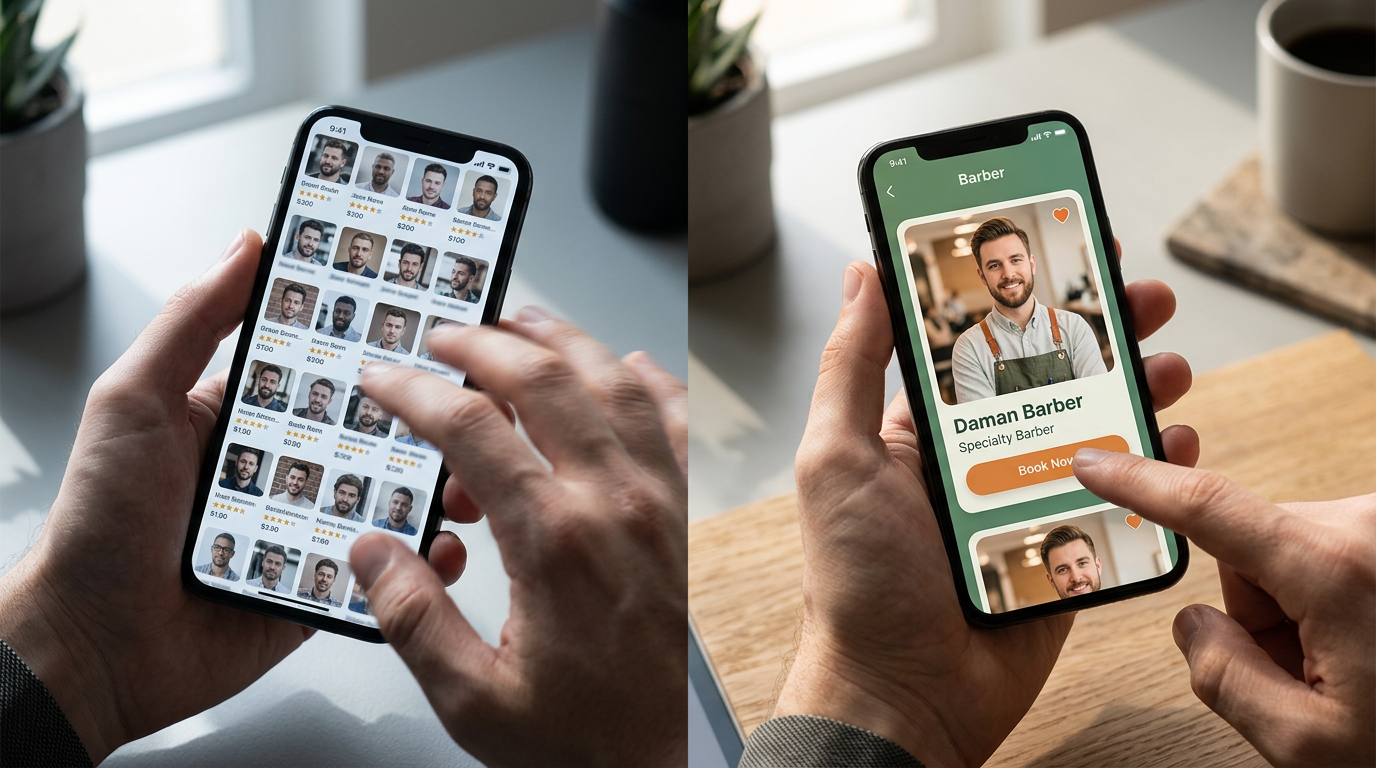
What Booksy Actually Is (And What It Isn't)
Booksy is a marketplace. Not a recommendation engine, not a quality filter — a marketplace. Any barber who pays the monthly subscription fee can create a profile, upload photos (of varying authenticity), set their prices, and start accepting bookings. The platform doesn't vet the barbers. It doesn't verify the photos are actually their work. It doesn't check if that five-star rating came from the barber's mom or a paying customer.
Think of it like Yelp with a built-in booking button.
The ranking you see when you search "barber near me" on Booksy isn't based on quality. It's based on:
- How much the barber pays (premium listings rank higher)
- How recently they joined or updated their profile
- Geographic proximity
- How many reviews they have (not the content of those reviews)
That last point matters. A barber with 200 reviews averaging 3.8 stars will often rank above a barber with 15 reviews averaging 5.0 stars. Volume beats quality in the algorithm. The platform optimizes for engagement and transaction volume, not for whether you walk out with a haircut you're proud of.
This isn't a criticism of Booksy's business model — it's just what directories do. Craigslist doesn't vet apartment listings. Airbnb started the same way before adding verification layers after enough problems. The question isn't whether Booksy is "bad" — it's whether a directory is the right tool for what you're trying to accomplish.
How listings work and who controls the ranking
Here's what happens when a barber signs up for Booksy:
- They create a profile (10 minutes, no verification)
- They upload portfolio photos (no requirement to prove the work is theirs)
- They set their service menu and prices
- They start appearing in search results immediately
No one from Booksy visits the shop. No one checks if the barber has proper licensing (required in most states). No one verifies the "before and after" photos weren't pulled from Instagram. The barrier to entry is a credit card and 10 minutes.
The ranking algorithm prioritizes:
- Premium subscribers — barbers who pay extra for "featured" placement
- Profile completeness — shops with more photos, detailed bios, and filled-out service menus rank higher
- Booking velocity — shops that get a lot of bookings (regardless of outcomes) get boosted
- Review count — not review quality, but total number
What doesn't affect ranking:
- Customer satisfaction after the appointment
- Cancellation rates
- Whether the barber actually showed up
- Repeat booking rate (the best indicator of quality)
You're not searching a curated list. You're searching a paid directory sorted by engagement metrics.
The Directory Problem: More Options Isn't Always Better
I just opened Booksy and searched "barber" in a mid-sized city. 63 results.
How do you choose?
The top result has 847 reviews and a 4.6-star average. Sounds good until you read the reviews. Half are five stars ("Great cut!"), half are one star ("Waited 45 minutes past my appointment time, then got a haircut that looked nothing like the photo I showed him"). The average rating tells you nothing useful.
The second result has 12 reviews, all five stars, all written in the last three weeks. That's not a sign of quality — that's a sign of a new barber asking friends to leave reviews.
The third result has no reviews, but the profile photo is a professional headshot and the portfolio shows immaculate fades. Could be great. Could also be photos stolen from a barber in another city. You have no way to know without booking and finding out.
This is the paradox of choice in action. Research shows that when people are presented with too many options of similar quality, they either:
- Choose based on irrelevant factors (profile photo attractiveness, proximity by half a mile)
- Spend so much time comparing that they get decision fatigue and pick randomly
- Avoid choosing altogether
Why 47 results for 'barber near me' is not useful information
Let's say you're looking for a barber who's good with thick, curly hair and can do a proper taper fade. You search Booksy. You get 47 results.
Now what?
You can filter by:
- Distance (but the closest barber isn't necessarily the best)
- Price (but cheap often means inexperienced, and expensive doesn't guarantee quality)
- Rating (but we've established ratings are gamed)
- Availability (but a barber with tons of open slots might have them for a reason)
You can't filter by:
- Actual skill with your hair type
- Consistency (does this barber deliver the same quality every time, or is it a coin flip?)
- Whether the barber listens to what you ask for
- Whether the photos in the portfolio are actually this barber's work
So you do what everyone does: you click on a few profiles, skim the reviews, look at the photos, and make a semi-educated guess. Then you book, show up, and hope.
Sometimes it works out. Often it doesn't. And when it doesn't, you're back on Booksy, scrolling through the same 47 results, trying to figure out which one to gamble on next.
The problem isn't that Booksy gives you options. The problem is it gives you undifferentiated options and expects you to do the research to figure out which ones are actually good.
What a Curated Platform Does Differently
A curated platform starts with a different question: "Which barbers should we show you?" instead of "How many barbers can we list?"
The difference is the difference between a Costco and a convenience store. Costco carries 4,000 SKUs. A typical grocery store carries 40,000. Costco's entire value proposition is: we've already done the work of figuring out which products are worth carrying. You're not choosing between 47 brands of olive oil — you're choosing between two, and both are good.
A curated barbershop booking platform works the same way. Instead of listing every barber who pays a fee, it lists only barbers who meet specific criteria:
- Verified portfolio (someone actually visited the shop or confirmed the work)
- Consistent positive feedback (not just volume of reviews, but repeat customers)
- Proper licensing and insurance
- Demonstrated skill with a range of hair types and styles
The platform makes money by being right about which barbers to recommend — not by maximizing the number of listings.
Vetted reviews vs. self-reported profiles
On Booksy, reviews are self-reported. Anyone can leave a review. The barber can't delete bad reviews, but they can:
- Ask friends and family to leave five-star reviews to dilute the bad ones
- Offer discounts in exchange for reviews
- Create multiple accounts and review themselves (it happens more than you'd think)
There's no verification that the person leaving the review actually got a haircut there. There's no verification that the review is about the barber currently working at that shop (barbers move around — reviews don't).
A curated platform typically uses:
- Verified bookings only — you can only review a barber if you booked through the platform and the appointment was completed
- Repeat booking rate — the percentage of customers who come back to the same barber (the single best indicator of quality)
- Cancellation tracking — if a barber cancels frequently, that's a red flag
- Response time — how quickly the barber confirms appointments and responds to questions
The reviews still matter, but they're contextualized. A four-star review from someone who's been to that barber six times is more valuable than a five-star review from someone who went once.
One recommendation vs. a list you have to sort through
Here's the workflow difference:
Booksy:
- Search "barber near me"
- Get 40+ results
- Click through 10-15 profiles
- Read reviews, look at photos, compare prices
- Make a guess
- Book
- Hope
Curated platform:
- Enter your address and what you're looking for (fade, beard trim, etc.)
- Get 1-3 recommendations
- Book the one that fits your schedule
- Show up knowing the barber has been vetted
The time difference is 15 minutes vs. 2 minutes. The confidence difference is "I think this will be fine" vs. "I know this will be fine."
You're not paying for more options. You're paying for fewer, better options. Book a vetted barber near your address in under 3 minutes and the difference becomes immediately obvious.
When Booksy Makes Sense and When It Doesn't
Booksy isn't always the wrong choice. There are scenarios where a directory is exactly what you need:
Booksy makes sense when:
- You already know which barber you want (you're just using Booksy as the booking interface)
- You're in a small town with limited options and you're willing to try whoever's available
- You're looking for a specific service that's hard to find (like a barbershop that does kids' cuts or specializes in long hair)
- You're price-sensitive and willing to trade convenience for cost
- You're traveling and need a quick cut in an unfamiliar city (you're already taking a chance, might as well have options)
A curated platform makes sense when:
- You've been burned by random online bookings before
- You care more about quality than about having 50 options
- You don't want to spend 20 minutes researching barbers every time you need a haircut
- You have a specific hair type or style that requires skill (curly hair, textured fades, anything beyond a basic buzz cut)
- You value your time more than you value saving $5-10 on the haircut
The honest answer: most guys who've been getting haircuts for more than a few years have a story about booking online, showing up, and walking out with a haircut that looked nothing like what they asked for. If that's you, a directory isn't solving your problem — it's just giving you more ways to repeat the same mistake.
For a deeper look at how to communicate what you actually want once you're in the chair, read what to ask for once you've found the right barbershop.
The Booking Experience: Side-by-Side
Let's compare the actual booking process. I just tested both for a standard men's haircut in the same city.
Time to confirmed appointment
| Step | Booksy | Curated Platform |
|---|---|---|
| Search/browse | 8 minutes (scrolling through profiles) | 30 seconds (one recommendation based on location) |
| Select barber | 3 minutes (reading reviews, comparing) | 10 seconds (already vetted) |
| Choose service | 1 minute (navigating service menu) | 15 seconds (simplified menu) |
| Pick time slot | 2 minutes (checking availability across days) | 20 seconds (shows next available) |
| Fill out booking form | 2 minutes (name, phone, email, create account) | 45 seconds (streamlined form) |
| Confirmation | Instant email | Instant email + SMS |
| Total time | 16 minutes | 2 minutes |
Fields required
Booksy asks for:
- Full name
- Phone number
- Email address
- Create password
- Agree to terms
- Marketing preferences (opt-out required)
- Sometimes: additional notes about what you want
Curated platform typically asks for:
- Name
- Phone number
- Service type (from simplified menu)
- Any specific requests (optional)
The difference: Booksy is optimizing for building a user database. A curated platform is optimizing for getting you booked.
Confirmation clarity
I booked the same service (men's haircut) on both platforms. Here's what the confirmation looked like:
Booksy confirmation email:
- Barber name
- Shop address
- Date and time
- Service booked: "Men's Haircut"
- Price: $35
- Cancellation policy: "Cancel up to 24 hours before"
- Link to add to calendar
Curated platform confirmation:
- Barber name and photo
- Shop address with parking notes
- Date and time
- Service: "Men's Haircut (includes consultation, cut, style)"
- Price: $40
- What to expect: "Your barber will start with a consultation to understand what you're looking for. Bring a reference photo if you have one."
- Cancellation policy with specific instructions
- SMS reminder sent 24 hours before
- Direct link to reschedule if needed
The extra $5 buys you clarity and context. You know what's included, what to bring, and what to expect when you walk in.
For first-time visits, that context matters. Check out how to not get a bad cut at a new barbershop for what to do once the appointment is booked.
Which One Is Right for You?
Here's the decision framework:
If you're the kind of person who:
- Enjoys researching and comparing options
- Doesn't mind spending 15-20 minutes to save $5-10
- Is comfortable taking a chance on an unknown barber
- Wants maximum flexibility and the widest possible selection
...then Booksy is a reasonable tool. It gives you access to every barber in your area who's willing to pay for a listing. You're doing the curation work yourself.
If you're the kind of person who:
- Has been burned by bad online bookings before
- Values your time more than marginal cost savings
- Wants someone else to do the research and vetting
- Prefers one good recommendation over 50 mediocre options
...then a curated platform is worth the slight premium. You're paying for pre-selection, not just access.
The wrong choice is using Booksy and then being surprised when the barber with 500 reviews and a 4.5-star average gives you a haircut that looks like it was done in a garage. The reviews told you that would happen — half of them said exactly that. You just hoped you'd get lucky.
A directory shows you everyone. A curated platform shows you the ones who are actually good. The difference is the difference between a Yelp search and asking a friend who knows the neighborhood. Both work. One works better.
For most guys, the question isn't "Should I use Booksy or a curated platform?" It's "How many bad haircuts am I willing to sit through before I pay $5 more for a guarantee?"
The answer to that question tells you which tool to use.